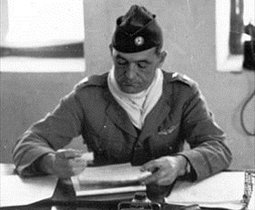
Courtesy of the ProQuest National Archives. Chennault in his Kunming office, May 1942. He wears a US Army brigadier general's star on his left shoulder but Chinese insignia otherwise.
April 1937
Captain Chennault of the United States Army Air Corp accepts an offer from Madam Chiang Kai-Shek to reorganize the chaotic Chinese Air Force.
July 1937
Marco Polo Bridge incident.
Japanese troops carried out intensive military training maneuvers.
August 8 1937
Japanese forces begin attack on Chinese at Nankou.
August 8 1937
Beijing falls to Japanese forces.
Captain Chennault of the United States Army Air Corp accepts an offer from Madam Chiang Kai-Shek to reorganize the chaotic Chinese Air Force.
July 1937
Marco Polo Bridge incident.
Japanese troops carried out intensive military training maneuvers.
August 8 1937
Japanese forces begin attack on Chinese at Nankou.
August 8 1937
Beijing falls to Japanese forces.
Courtesy of the National Archives
(Battle of China, 1944)
(Battle of China, 1944)
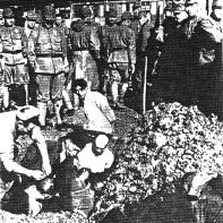
Courtesy of The Nanjing Massacre: Scenes from a Hideous Slaughter 75 Years ago
Chinese prisoners are buried alive by their Japanese captors outside the city of Nanjing.
|
September 21 1937
Japanese army air service commences aerial bombing of Nanking. The fall of Nanking was perhaps the most brutal massacre in the history of the war, known as "The Rape of Nanking".
1937
Chennault returns to America to obtain new planes, train pilots, and assist in building a new Chinese Air Force. The American Air Corps did not fully understand the threat the Japanese posed.
Early 1939 - 1940
Multiple Japanese air raids and sustained bombing against heavily populated areas in China took place.
Japanese army air service commences aerial bombing of Nanking. The fall of Nanking was perhaps the most brutal massacre in the history of the war, known as "The Rape of Nanking".
1937
Chennault returns to America to obtain new planes, train pilots, and assist in building a new Chinese Air Force. The American Air Corps did not fully understand the threat the Japanese posed.
Early 1939 - 1940
Multiple Japanese air raids and sustained bombing against heavily populated areas in China took place.
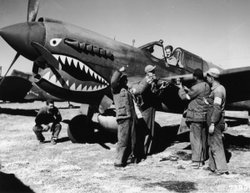
Courtesy of The China File
A Photograph of Chinese Soldiers and Armorers of 74th Fighter Squadron Inspecting a Curtiss P-40 in Kunming, China, February 1, 1943.
Fall 1940
Chennault recruits American pilots and obtains American planes which lead to the organization of the American Volunteer Group.
Mid-April 1941
President Roosevelt signs executive orders for Lend-Lease Act to be carried out.
President Roosevelt responding to the Soviet-Japanese Neutrality Pact and after hearing from Claire Chennault, who Madame Chiang Kai-Shek had hired him to train Chinese pilots, decided to help China build a modern air force. The President signed, but did not publish an Executive Order permitting U.S. military personnel to resign so that they could participate in a covert operation to support China. (mid-April 1941)
March 11 1941
Lend-Lease Act is initiated
August 1 1941
American Volunteer Group (AVG) Flying Tigers is founded in Kunming with 100 P-40 fighter planes delivered to Burma and tested by the Central Aircraft Manufacturing Corporation.
December 7 1941
The Japanese bomb Pearl Harbor.
December 20 1941
First combat for the Flying Tigers
January-May 1942
Japanese invasion of Burma
March 5 1942
Lend-Lease Act is terminated
July 4 1942
American Volunteer Group officially disbanded
July 1942-March 1943
China Air Task Force (CATF)
March 10 1943- December 1945
14th Air Force Flying Tigers were activated and replaced the China Air Task Force
Chennault recruits American pilots and obtains American planes which lead to the organization of the American Volunteer Group.
Mid-April 1941
President Roosevelt signs executive orders for Lend-Lease Act to be carried out.
President Roosevelt responding to the Soviet-Japanese Neutrality Pact and after hearing from Claire Chennault, who Madame Chiang Kai-Shek had hired him to train Chinese pilots, decided to help China build a modern air force. The President signed, but did not publish an Executive Order permitting U.S. military personnel to resign so that they could participate in a covert operation to support China. (mid-April 1941)
March 11 1941
Lend-Lease Act is initiated
August 1 1941
American Volunteer Group (AVG) Flying Tigers is founded in Kunming with 100 P-40 fighter planes delivered to Burma and tested by the Central Aircraft Manufacturing Corporation.
December 7 1941
The Japanese bomb Pearl Harbor.
December 20 1941
First combat for the Flying Tigers
January-May 1942
Japanese invasion of Burma
March 5 1942
Lend-Lease Act is terminated
July 4 1942
American Volunteer Group officially disbanded
July 1942-March 1943
China Air Task Force (CATF)
March 10 1943- December 1945
14th Air Force Flying Tigers were activated and replaced the China Air Task Force
Copyright
